Cashew shell burner — 200,000 to 900,000 kcal/h
Specialised combustion for cashew-shell fuel.
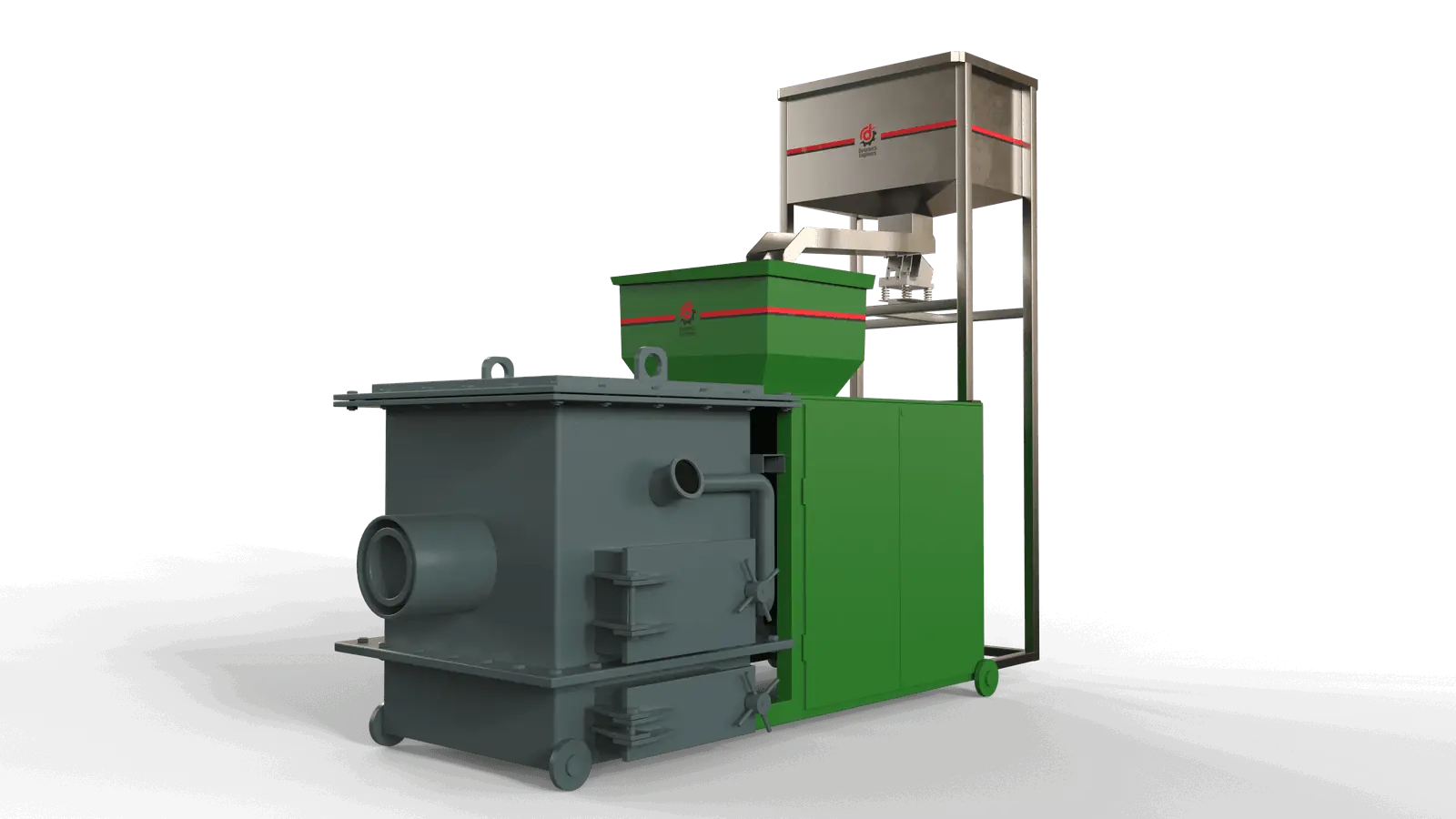
A cashew shell burner fires cashew shell — CNSL-rich, acidic and corrosive — through staged pyrolysis rather than direct combustion. SahelDry units are rated 200,000 to 900,000 kcal/h, gasify the shell in an oxygen-limited chamber, then burn the resulting gas for complete combustion of the oil fraction.
Cashew shells are an awkward waste stream — produced in volume, hard to dispose of, and difficult to burn cleanly in general-purpose equipment. They are also excellent fuel. Our burner is engineered specifically around that combination.
Indicative price, Ex-Works (EXW): USD 1,050–12,750
Shipping, customs clearance and local duties are extra. The final price depends on the configuration and is fixed in the written quotation.
 200–900kkcalIllustrative
How CNSL is managed in combustion
Burn the oil, don’t chase the smoke.
Cashew nut shell liquid (CNSL) makes the shell energy-dense but also causes it to burn hot, fast and smokily in an uncontrolled fire, with heavy tar deposition on cooler surfaces.
The pyrolysis approach addresses this directly: gasifying the shell in an oxygen-limited chamber and burning the resulting gas gives complete combustion of the oil fraction rather than driving it off as smoke and tar. This is why a general-purpose solid-fuel burner will disappoint on cashew shell and a purpose-designed one will not.
Technical specifications
| Parameter | Value |
|---|---|
| Capacity | 200,000 to 900,000 kcal/h, specified to load |
| Main motor | 3 HP, Crompton Greaves, VFD-controlled |
| Main blower | 0.5 HP |
| Sub-blower & throw fan | Supplementary combustion-air distribution |
| Feed screw | 1 HP premium drive, VFD-controlled |
| Furnace construction | Fire cement rated to 2000 °C |
| Grill | Special steel; stainless option available as a spare |
| Control | Delta PLC & HMI on a common panel |
| Warranty | 12 months from date of shipment |
Key components
- Vibro feeder & hopper — Apex Industries VIB-72DA vibrator, delivering shells at a consistent metered rate.
- Wide screw conveyor — transports shells into the burning chamber without bridging or jamming.
- Air-cooled combustion chamber — manages the high flame temperatures characteristic of oil-bearing shell.
- Ash collection — bottom chamber with removal access.
- Air heat exchanger — indirect transfer to process air, so combustion products never contact your product.
Regional & commercial impact
- Disposal problem eliminated — the shell pile stops being a cost centre.
- Processing energy self-sufficiency — cashew processors can generate the majority of their own process heat from their own residue.
- Local fuel-market creation — where a drying operation sits near cashew processing, a shell supply chain becomes commercially viable for both parties.
- Operating-cost reduction — substantial displacement of purchased fuel.
Where this equipment is used
The same equipment is specified across several product classes. These are the ones it is configured for most often:
the commissioned installation at PCCL in The Gambia, tree nut and oilseed drying, industrial mango drying system and fish and seafood drying.
Each of those pages carries the drying parameters, cycle times and quality targets for that product class.
A burner engineered for cashew shell handles cleaner fuels without difficulty. If your supply is mixed, or you expect to run pellets and briquettes alongside shell, the multi-fuel biomass burner covers the same 200,000–900,000 kcal/h range across the full fuel envelope.
One system has been commissioned so far: a 900,000 kcal/h cashew shell burner firing a steam boiler at Premium Cashew Commodities Limited in The Gambia, on the factory’s own empty shell. It is a boiler application — no drying line has been built anywhere yet, so every drying figure on this site remains an engineered design target. The configuration is published in full, and the measured performance deliberately is not, on the page for the PCCL installation in The Gambia.
Frequently asked questions
Why does cashew shell need a purpose-built burner?
The shell carries 15–25 % CNSL, an acidic phenolic liquid with a pH of 4.5–5.2. Burned carelessly it corrodes refractory, fouls tubes and smokes. Staged pyrolysis decomposes the corrosive fraction before combustion, which a general-purpose solid-fuel burner does not do.
What happens to the ash and char?
The bottom chamber collects ash, removed daily as an operator task. The process also leaves a carbon-rich residue — biochar — recovered as a saleable by-product rather than treated purely as waste. Ash volume scales with firing rate, so a burner at the top of the 200,000 to 900,000 kcal/h range makes more of both.
What if my shell supply is seasonal?
The same burner accepts 90 × 90 mm agricultural briquettes and commercial pellets, rated 3,800 to 4,500 kcal/kg depending on the residue. A burner engineered for shell handles cleaner fuels without difficulty; the fallback fuel does need naming at the sizing stage.
Request a quotation
We size against calculated heat demand — not headline capacity. Tell us your load and we’ll specify the right unit.
Request a quote